


By Dela Ahiawor
When David Bowie’s death was confirmed a decade ago, on January 11, 2016, Journalist Dela Ahiawor then in London, joined a crowd of devotees in Brixton, Bowie’s birthplace. Dela Ahiawor, now CAJ West Africa Bureau editor, looks back on Bowie’s environmental advocacy.
By Dela Ahiawor
In an era where sustainable practices within the music industry (music sustainability) is gaining traction, famous English rockstar, David Bowie’s contribution to environmental awareness in the 1970’s is worth recalling.
This is to help inspire contemporary artistes (musicians) to join the global campaign against the worsening climate catastrophe.
David Bowie, originally known as, David Robert Jones was a world renowned singer, songwriter and actor who in the 70s, was a voice for nature (environmental protection). He was an acclaimed rockstar in the 70s and a global icon, who was named as one of the the most influential music icons of the 20th century.
Born on January 8, 1947; Bowie died in New York City on 10 January, 2016 at the age of 69 diagnosed with liver cancer.
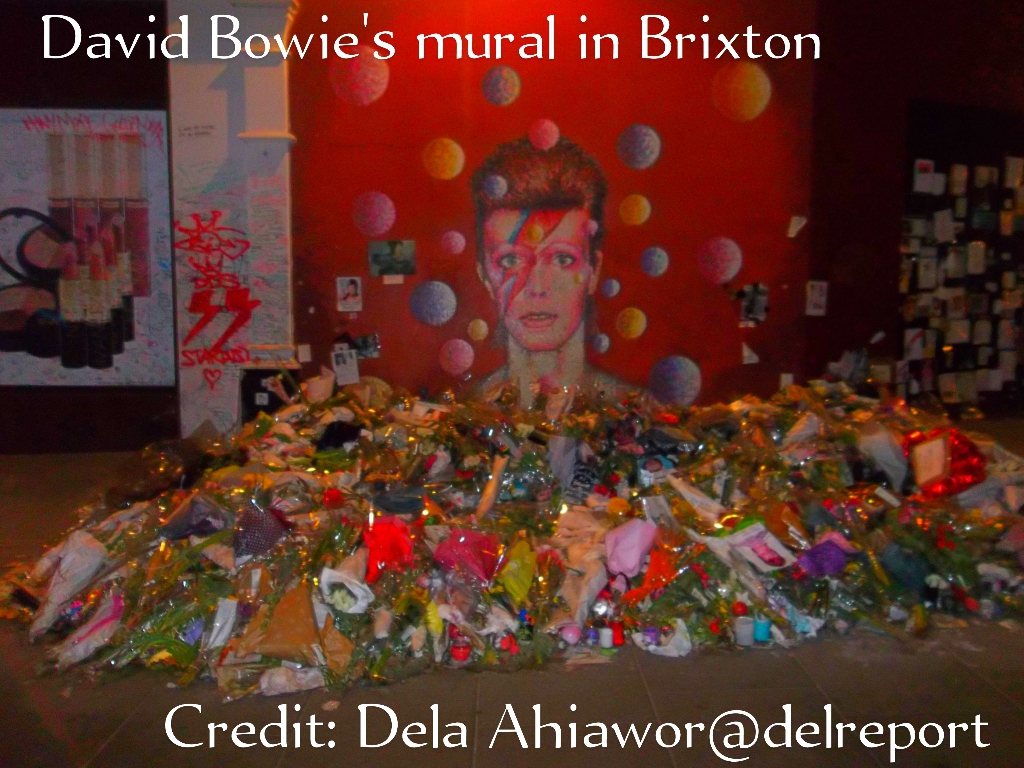
When the world learned of David Bowie’s death a day after his death on the evening of 11 January, 2016, this writer then in London, braved the winter chill to join a crowd of admirers in Brixton, Bowie’s birthplace to offer thoughts/ sympathies for the music icon. But more importantly, this writer’s presence in Brixton was to pay tribute to the music icon’s environmental advocacy in the 70s.
In Brixton, a suburb in south London where David Bowie was born, a mural of of his iconic visage (face) with the lightning- bolt flash greeted sympathizers, just beside Morleys department store. This iconic image of Bowie was inspired by his famous alter ego, Ziggy Stardust which he adopted in 1972. The other alter egos were: Aladdin Sane, the Thin White Duke, Major Tom and Jareth the Goblin King.
Floral tributes grew in front of Bowie’s iconic mural. Among the grieving mourners, soapbox orators surfaced on the streets of Brixton touting the unique talents of David Bowie. Hundreds of devotees also caroused and danced the night away on the streets and on Windrush Square in Brixton, London to celebrate Bowie and not just mourn his demise.
Ten years after his passing, Bowie’s mural in Brixton which was painted in 2013, by Australian artist James Cochran, aka Jimmy C., is being considered to be preserved as a permanent memorial for posterity.
Indeed David Bowie was a global icon, acclaimed for his innovative music, unique style. His influence spanned across music, fashion, art and identity. For that reason, he was honoured with a stone on Camden’s Music Walk of Fame.
In his years of work, David Bowie displayed a great concern for environmentalism- by using his iconic persona/ alter go: ‘Ziggy Stardust” and music: “Five Years” to champion climate action during the emerging years of environmental awareness.
The lyrics of Bowie’s song, “Five Years”, which was one of the songs on the 1 972 album: “The Rise and Fall of Ziggy Stardust and the Spiders from Mars” was released (performed) for “Friends of the Earth (FoE)” and the “Save the Whale” campaign during the Benefits Concerts in London in 1972. The song, “Five Years” warned that humanity had only five years left before the destruction of the earth. The album release coincided with the first United Nations Conference on the Human Environment in Stockholm, Sweden in 1972. This was the first climate talks that prioritized environmental protection worldwide in the early 70s.
As a dolphin lover, Bowie advocated for animal rights. He discounted (reduced) the fee for his song “Heroes” to be used for the 2009 American documentary film “The Cove”, which decried the hunting of dolphins in Taiji, Japan. The documentary was used to raise funds to support maternal and childcare programs around the world.
A the 21st Conference of the Parties (COP21) in Paris, France in November, 2015, Bowie signed a petition calling for climate action before his death, this demonstrates an unwavering commitment to the environment.
Ten years on, global climate action is still insufficient to combat the climate crisis. In fact, the climate crisis has intensified, marked by increasing global temperatures. The need therefore, arises to accelerate climate advocacy globally, aiming to reverse the worsening climate catastrophe.
To this end, the music sustainability industry is encouraging musicians to
reduce their environmental impact. As a result, the music sector has joined the global effort to combat climate action by implementing sustainability best practices for their events.
Currently, the music industry is demonstrating the potential for artistes to harness the power of music and culture for the common good of humanity.
www.delreport.com