


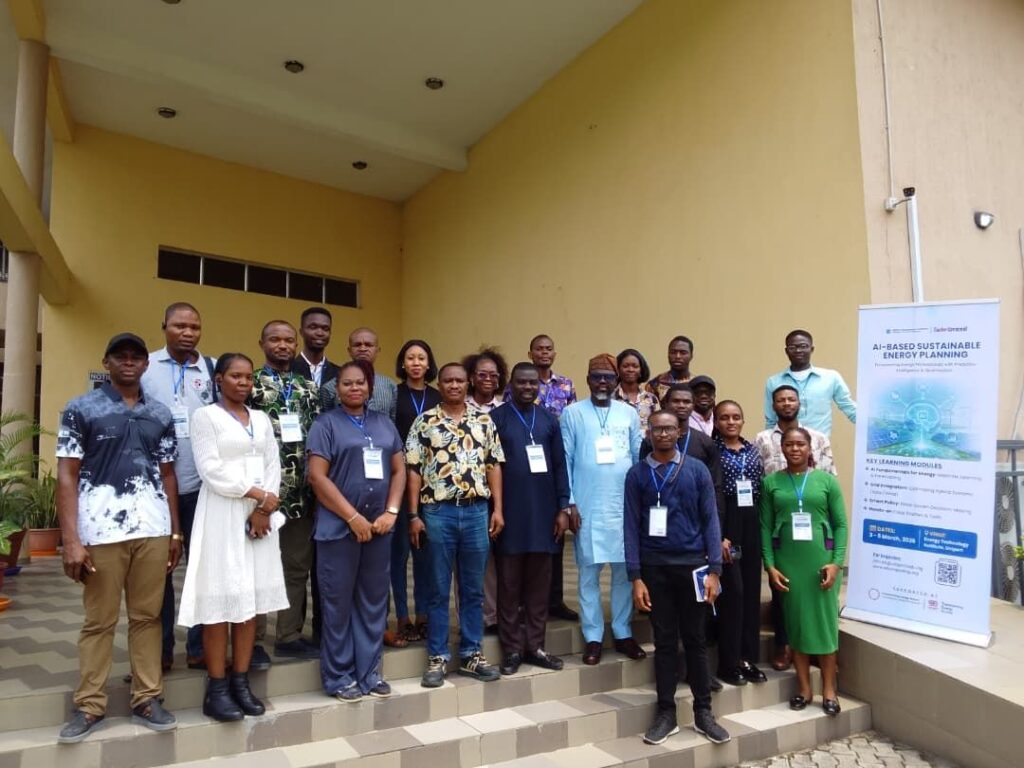
“A three-day intensive programme brought together international facilitators to equip energy professionals with artificial intelligence tools for sustainable planning and grid optimisation.”
The Energy Technology Institute (ETI) at the University of Port Harcourt, in partnership with CypherCrescent, successfully concluded a landmark training programme that equipped energy professionals across Africa with cutting-edge artificial intelligence skills.
The AI-Based Sustainable Energy Planning course, which ran from 3 to 5 March 2026, represented one of the most ambitious efforts yet to bridge the gap between AI innovation and real-world energy challenges on the continent.
Funded by UKAid through the Transforming Energy Access Learning Partnership (TEA-LP), the programme targeted practising engineers, policy analysts, and energy planners who sought to integrate machine learning, predictive intelligence, and data-driven decision-making into their professional toolkit.
An International Faculty Delivered Global Expertise
The programme drew its strength from a faculty spanning three continents. Professor Lawrence Agbemabiese, a leading voice in energy sustainability based in the United States, joined Professor Ogheneruona Diemuodeke, a respected figure in Nigeria’s engineering research community. Completing the international panel was Ms. Daisy Ogbonnia, a UK-based AI and technology expert who brought a distinctly global perspective to the curriculum.
Ogbonnia’s participation reflected a growing trend of diaspora professionals contributing — in person or virtually — to capacity-building efforts across sub-Saharan Africa. Her expertise in the intersection of technology and sustainable development added a dimension particularly valued by participants navigating both local energy realities and international best practices.
“The energy transition in Africa will not happen through technology alone — it requires people who understand both the data and the context,” said Ogbonnia. “This workshop was about building exactly that kind of capacity, and the results were remarkable.”
What Participants Learned
The curriculum was structured around four core modules, each combining theoretical grounding with hands-on application:
• AI Fundamentals for Energy: Participants explored machine learning principles and forecasting models tailored to the energy sector, including geospatial analysis using real Nigerian datasets.
• Grid Integration: Sessions focused on optimising hybrid renewable systems, with particular attention to solar and wind infrastructure and site selection tools.
• Smart Policy: Participants applied data analytics and multicriteria analysis to energy governance and policy formulation.
• Hands-on Case Studies & Tools: Working with platforms such as GeoPandas, Rasterio, and scikit-learn, participants processed real-world datasets and produced actionable energy access suitability models.
Professor Agbemabiese argued that AI is fundamentally reshaping who gets to compete in the energy planning space.
“For a long time, we’ve pursued energy visions but lacked the shortcuts,” he said. “AI tools are now giving a young entrepreneur in Accra, Abuja, or Nairobi the same analytical firepower as a global firm. This democratisation of AI is enabling them to start building the future right now.”
With only 30 seats available, the programme was intentionally compact — a design choice that organisers said prioritised depth of engagement over volume of participants. All places were filled ahead of the start date.
“Facilitating this workshop showed me that Africa’s energy sector is moving beyond conventional planning toward intelligent, data-driven decision-making,” said Professor Diemuodeke. “Training professionals in AI now matters because it builds the local capacity needed to lead Africa’s energy transition with precision, speed, and ownership.”
A Strategic Moment for Africa’s Energy Sector
The programme concluded at a pivotal moment. Sub-Saharan Africa continues to face an acute energy access challenge, with millions still lacking reliable electricity. The rapid decline in the cost of solar and wind technologies has opened new possibilities for leapfrogging traditional grid infrastructure — but only where planners have the analytical skills to design and optimise such systems.
Initiatives like this one signalled a growing recognition within African academic institutions that the tools of the fourth industrial revolution — AI, big data, and advanced modelling — are not luxuries reserved for wealthier economies, but essential instruments for tackling the continent’s most pressing development challenges. Organisers are expected to announce future editions of the programme later this year.
Source: delreport.com